Rabu, 03 Mei 2017

Here's what happens to your body when you walk those recommended 10,000 steps


Embed
Share
You've probably heard that you should strive to take 10,000 steps a day. But you might be surprised how beneficial doing that can really be.

Woman using activity tracker. (Photo: gregory_lee, Getty Images/iStockphoto)
Even if you don't have a fitness tracker like a Fitbit, you've probably heard that you should strive to take 10,000 steps a day.
But where did the 10,000 step recommendation come from? And what happens to your body when you take 10,000 steps?
Ten thousand steps was first popularized by Japanese pedometers in the 1960s under the name "manpo-kei," which means "10,000 steps meter," according to UC Davis Integrative Medicine. Today, taking 10,000 steps a day is a popular goal because some research has shown coupled with other healthy behaviors it can lead to a decrease in chronic illness like diabetes, metabolic syndromes and heart disease, according to Michael Roizen, a physician and chief wellness officer at Cleveland Clinic.
"If you look at it, if everyone did just 10,000 steps a day in America we would probably decrease healthcare budget by $500 billion a year and that shows how few people actually do it, and two how big a reduction in chronic disease we’d have if more did," according to Roizen, who is also author of Age Proof: Living longer without running out of money or breaking a hip.
While the Centers for Disease and Control doesn't specifically recommend10,000 steps a day, it does suggest people get at least 150 minutes of moderate activity each week (30 minutes a day) coupled with two or more days of muscle-strengthening activity.
The guidelines suggest Americans get some physical activity and reduce sedentary time, which will ultimately benefit their health, according to Neil Johannsen, assistant Professor in the School of Kinesiology at Louisiana State University.
He said some research shows that adults aiming for the 150 minutes a week typically walk around 7,500 steps a day.
"So, taking that standpoint,10,000 steps represents that highest level in most adults," Johannsen said. "It’s that do more than what is recomended and you will see further benefits to your health."
And the benefits over 10,000 steps may be substantial. Roizen points to a recent study, that found postal workers in Glasgow, Scotland, who walked 15,000 steps a day, had fewer risk factors for heart disease than colleagues who sat throughout the day.
While the study published in the The International Journal of Obesity, doesn't identify 10,000 steps, 15,000 is pretty close, Roizen said.
At the end of the day, whether you're walking 8,000 or 13,000 steps a day, it's key to get moving, he said.
Here's a look at how you can get started:
Get a pedometer
Pedometers not only monitor physical activity, but also keep people interested in physical activity, Johannsen said.
"Most people get started with a program and miss a week because of life and then they quit," he said. "I'm hoping these monitors keep people motivated enough so they go back to a physical activity program and meet their goals."
While 10,000 steps may seem like a lofty goal, it's easier than you think. Johannsen recommends the following:
- Whether it's at work or going to the grocery store, park your vehicle at the end of the parking lot so you get additional steps.
- Get up and move for 5-10 minutes every hour at work. Johannsen said people should make time to move during work so they aren't sedentary for long periods of time. "Get up and move to break up the sedentary time, and that may be just as important as 30 minutes of moderate physical activity each day," he said.
More coverage:
What happens if you don't sleep for 24 hours? You're basically drunk
Strawberries and these other foods have the most pesticides
Always keep these foods in your house for healthy eating
Build up your steps
For those who are nowhere near 10,000 steps a day, the goal should be to gradually increase the amount of steps you take each day, Johannsen said.
"If you are sedentary the whole goal of the physical activity guideline is to reduce sedentary time," Johannsen said. "If you are sitting there behind a desk it's best for you to start low in the 4,000 - 3,000 range, which is actually higher than what most sedentary people get for physical activity."
In order to avoid injury people who have been fairly sedentary should make sure they take it slow, according to Roizen.
"The goal is just to do four steps more today than you did yesterday," Roizen said. "This is a hazard with guys more than women where they say 'I felt so good I did 4,000 steps more than I did yesterday, or than I did in the last 10 years,' an they injure themselves of develop pain because they went so far, so fast."
Follow Mary Bowerman on Twitter: @MaryBowerman
(Photo: File)
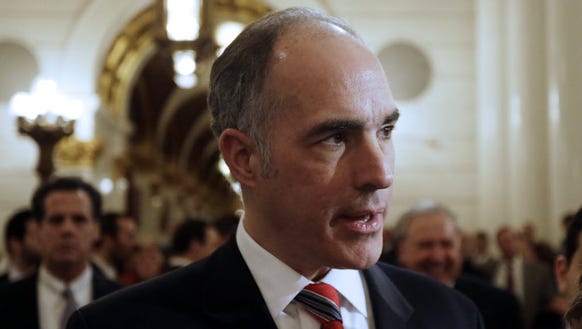
Sen. Bob Casey has mounted a campaign to stop the deportation of a mother and her 5-year-old daughter to Honduras, where he says they will be targeted by gangs.
On Wednesday, Casey tweeted a stream of information about the situation and made an appearance on MSNBC. According to tweets, the deportation was in progress on Wednesday afternoon.
Twitter: it's urgent. I just found out that a young child & her mother who came to U.S. seeking refuge will be sent back to Honduras today.
— Senator Bob Casey (@SenBobCasey) May 3, 2017
"This 5yr old and his mother aren't 'bad hombres.' They aren't in a gang, they're running from death- vulnerable and scared ... The child is potentially eligible for Special Immigrant Juvenile Status," tweeted Casey.
Casey also claimed that the Department of Homeland Security was aware the mother and child had "had secured paperwork to protect them" and had rushed removal to prevent the protection.
Casey said that DHS contacts claim that only the Trump administration can stop the deportation.
A request for comment from the Department of Homeland Security was not immediately returned.
Civil liberties groups pledge to fight expected Trump order on religious freedom
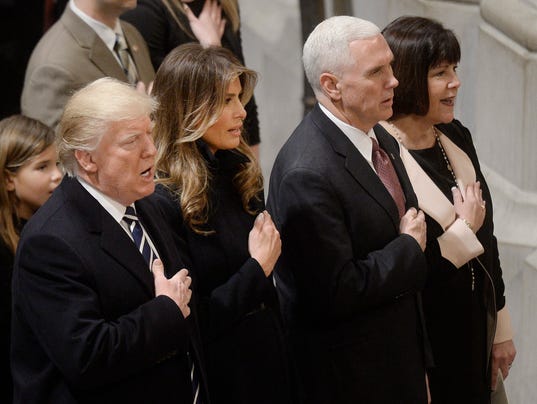
President Donald Trump, First Lady Melania Trump, Vice President Michael Pence and his wife Karen Pence attends the National Prayer Service at the Washington National Cathedral in Washington, DC, USA, 21 January 2017. (Photo: OLIVIER DOULIERY / POOL, EPA)
WASHINGTON – With President Trump expected to sign a controversial executive order on religious freedom as early as Thursday, civil liberties groups are already gearing up for a fight.
Lawyers for the American Civil Liberties Union and the Human Rights Campaign said they plan to immediately file legal challenges against the order, if it is as broad as a draft that leaked earlier this year. They're concerned Trump's actions will enable discrimination against gays and religious minorities, and allow many employers to deny birth control services in the health care plans they offer to workers.
“It would create an unprecedented license to discriminate with taxpayers’ funds, undermine women’s health care and elevate one narrow set of religious beliefs over all others,” said Sarah Warbelow, legal director for the Human Rights Campaign.
Trump is likely to at least discuss the executive order on Thursday, which is the National Day of Prayer. And the scene at the White House appears all set for a signing. “There could be no better day to sign an executive order on religious freedom than the National Day of Prayer,” said Mat Staver who heads the Liberty Counsel, a legal group that has fought against same-sex marriage.
And Vice President Pence, who set off a national firestorm when he signed a religious freedom law as governor of Indiana in 2015, was scheduled to host members of the White House’s “Evangelical Advisory Board” at a White House dinner Wednesday.
But two administration officials say that they're not certain whether any documents will be ready to sign. Trump officials and lawyers are still fine-tuning the details, including provisions to determine whether people can be compelled to provide services to gays or gay couples if it goes against their religious beliefs, the officials said under condition of anonymity, because plans are still in flux.
Trump also wants to curtail the so-called "Johnson Amendment," which says religious organizations cannot participate in political activity, the officials said. The administration is considering an order that would include a provision instructing the Treasury Department to ease off its enforcement of the Johnson Amendment. An American Civil Liberties Union lawyer Brigitte Amiri said the group was "exploring all options," including suing the government, in response to that action.
Even as the Trump administration finalizes its plans on this front, the opposition has begun: Gay and civil rights advocates protested in front of the White House Wednesday, saying the pending executive order is the latest Trump administration action that attacks the rights of immigrants, Muslims, women and members of the LGBTQ community.
Religious conservatives have long pushed Trump to renew what they say is an “appreciation for religious freedom” they say the Obama administration undermined despite a law created in 1993 to protect religious freedom.
“It’s simply bringing the federal government back in line with [the Religious Freedom Restoration Act],” Tony Perkins, president of the Family Research Council, said last month about the need for an executive order.
Ryan Anderson, senior research fellow at Heritage, said the executive order could “clarify in a strengthening way” how to apply the Religious Freedom Restoration Act, which which says a government can "substantially burden" a person's exercise of religion only if it advances an important government interest – and does so in the least restrictive way possible.
“If the prior administration interpreted existing federal law in a way that constricted religious liberty, this would be returning it to a robust understanding of religious liberty,” Anderson said.
During his campaign, Trump pledged that the “first priority of my administration will be to preserve and protect our religious liberty.”
Religious conservatives, though, waited anxiously for action – and some were disappointed when the White House announced in January that Trump would not undo President Obama’s executive order protecting employees from anti-LGBTQ workplace discrimination while working for federal contractors.
The administration emphasized at the time that Trump is proud to be the first Republican nominee to mention the LGBTQ community in his nomination acceptance speech and “is determined to protect the rights of all Americans, including the LGBTQ community.”
Perkins said the expected religious freedom executive order has been delayed in part because “there are some counterviews” within the administration about whether it’s necessary.
But he was optimistic it will come, and that Pence would provide “solid counsel that will be in line with what a lot of evangelicals feel and think.”
The state religious freedom law Pence backed as Indiana’s governor sparked a backlash over whether it would allow florists, bakers and others to deny services to gays and lesbians.
Those are not the services that would be affected by the executive order – at least as initially drafted, civil liberties lawyers said. Instead, the directive would primarily affect organizations which receive a significant amount of federal funding to provide services such as homeless shelters, hospice care, and child welfare services, the Human Rights Campaign's Warbelow said.
She said the draft version of the order would allow those organizations to discriminate against the LGBTQ community. A hospital, for example, could refuse to allow a same-sex partner to visit a dying spouse. A child welfare organization could refuse to place a child in care of a same-sex couple.
Federal workers could also discriminate, she said, such as refusing to process spousal benefits for the spouse of a same-sex couple.
“There is an intention here to allow federal employees to utilize their religious views on the subject matters in the course of their jobs,” Warbelow said.
The American Civil Liberties Union said the draft executive order would hurt women by allowing “almost any employer” to exclude contraceptive coverage – and other preventive care benefits required by the Affordable Care Act – from their insurance plans.
“This is discrimination against women plain and simple,” said the ACLU's Amiri.
The ACLU is looking at “multiple opportunities” for challenging the executive order in court, she said, “because this is so clearly a violation of the Constitution.”