Rabu, 03 Mei 2017

Here's what happens to your body when you walk those recommended 10,000 steps


Embed
Share
You've probably heard that you should strive to take 10,000 steps a day. But you might be surprised how beneficial doing that can really be.

Woman using activity tracker. (Photo: gregory_lee, Getty Images/iStockphoto)
Even if you don't have a fitness tracker like a Fitbit, you've probably heard that you should strive to take 10,000 steps a day.
But where did the 10,000 step recommendation come from? And what happens to your body when you take 10,000 steps?
Ten thousand steps was first popularized by Japanese pedometers in the 1960s under the name "manpo-kei," which means "10,000 steps meter," according to UC Davis Integrative Medicine. Today, taking 10,000 steps a day is a popular goal because some research has shown coupled with other healthy behaviors it can lead to a decrease in chronic illness like diabetes, metabolic syndromes and heart disease, according to Michael Roizen, a physician and chief wellness officer at Cleveland Clinic.
"If you look at it, if everyone did just 10,000 steps a day in America we would probably decrease healthcare budget by $500 billion a year and that shows how few people actually do it, and two how big a reduction in chronic disease we’d have if more did," according to Roizen, who is also author of Age Proof: Living longer without running out of money or breaking a hip.
While the Centers for Disease and Control doesn't specifically recommend10,000 steps a day, it does suggest people get at least 150 minutes of moderate activity each week (30 minutes a day) coupled with two or more days of muscle-strengthening activity.
The guidelines suggest Americans get some physical activity and reduce sedentary time, which will ultimately benefit their health, according to Neil Johannsen, assistant Professor in the School of Kinesiology at Louisiana State University.
He said some research shows that adults aiming for the 150 minutes a week typically walk around 7,500 steps a day.
"So, taking that standpoint,10,000 steps represents that highest level in most adults," Johannsen said. "It’s that do more than what is recomended and you will see further benefits to your health."
And the benefits over 10,000 steps may be substantial. Roizen points to a recent study, that found postal workers in Glasgow, Scotland, who walked 15,000 steps a day, had fewer risk factors for heart disease than colleagues who sat throughout the day.
While the study published in the The International Journal of Obesity, doesn't identify 10,000 steps, 15,000 is pretty close, Roizen said.
At the end of the day, whether you're walking 8,000 or 13,000 steps a day, it's key to get moving, he said.
Here's a look at how you can get started:
Get a pedometer
Pedometers not only monitor physical activity, but also keep people interested in physical activity, Johannsen said.
"Most people get started with a program and miss a week because of life and then they quit," he said. "I'm hoping these monitors keep people motivated enough so they go back to a physical activity program and meet their goals."
While 10,000 steps may seem like a lofty goal, it's easier than you think. Johannsen recommends the following:
- Whether it's at work or going to the grocery store, park your vehicle at the end of the parking lot so you get additional steps.
- Get up and move for 5-10 minutes every hour at work. Johannsen said people should make time to move during work so they aren't sedentary for long periods of time. "Get up and move to break up the sedentary time, and that may be just as important as 30 minutes of moderate physical activity each day," he said.
More coverage:
What happens if you don't sleep for 24 hours? You're basically drunk
Strawberries and these other foods have the most pesticides
Always keep these foods in your house for healthy eating
Build up your steps
For those who are nowhere near 10,000 steps a day, the goal should be to gradually increase the amount of steps you take each day, Johannsen said.
"If you are sedentary the whole goal of the physical activity guideline is to reduce sedentary time," Johannsen said. "If you are sitting there behind a desk it's best for you to start low in the 4,000 - 3,000 range, which is actually higher than what most sedentary people get for physical activity."
In order to avoid injury people who have been fairly sedentary should make sure they take it slow, according to Roizen.
"The goal is just to do four steps more today than you did yesterday," Roizen said. "This is a hazard with guys more than women where they say 'I felt so good I did 4,000 steps more than I did yesterday, or than I did in the last 10 years,' an they injure themselves of develop pain because they went so far, so fast."
Follow Mary Bowerman on Twitter: @MaryBowerman
(Photo: File)
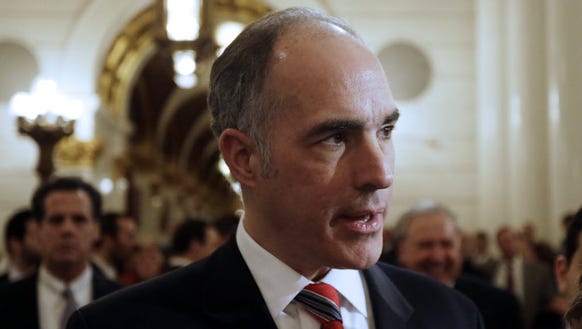
Sen. Bob Casey has mounted a campaign to stop the deportation of a mother and her 5-year-old daughter to Honduras, where he says they will be targeted by gangs.
On Wednesday, Casey tweeted a stream of information about the situation and made an appearance on MSNBC. According to tweets, the deportation was in progress on Wednesday afternoon.
Twitter: it's urgent. I just found out that a young child & her mother who came to U.S. seeking refuge will be sent back to Honduras today.
— Senator Bob Casey (@SenBobCasey) May 3, 2017
"This 5yr old and his mother aren't 'bad hombres.' They aren't in a gang, they're running from death- vulnerable and scared ... The child is potentially eligible for Special Immigrant Juvenile Status," tweeted Casey.
Casey also claimed that the Department of Homeland Security was aware the mother and child had "had secured paperwork to protect them" and had rushed removal to prevent the protection.
Casey said that DHS contacts claim that only the Trump administration can stop the deportation.
A request for comment from the Department of Homeland Security was not immediately returned.
Civil liberties groups pledge to fight expected Trump order on religious freedom
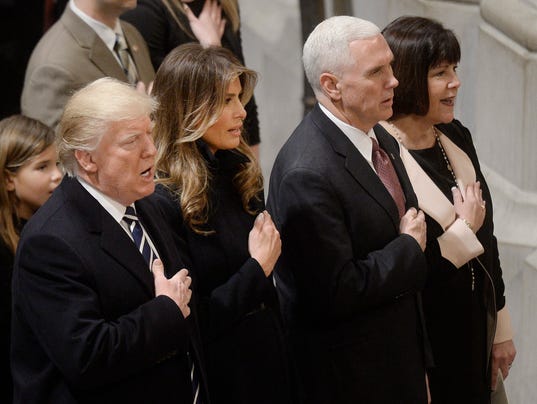
President Donald Trump, First Lady Melania Trump, Vice President Michael Pence and his wife Karen Pence attends the National Prayer Service at the Washington National Cathedral in Washington, DC, USA, 21 January 2017. (Photo: OLIVIER DOULIERY / POOL, EPA)
WASHINGTON – With President Trump expected to sign a controversial executive order on religious freedom as early as Thursday, civil liberties groups are already gearing up for a fight.
Lawyers for the American Civil Liberties Union and the Human Rights Campaign said they plan to immediately file legal challenges against the order, if it is as broad as a draft that leaked earlier this year. They're concerned Trump's actions will enable discrimination against gays and religious minorities, and allow many employers to deny birth control services in the health care plans they offer to workers.
“It would create an unprecedented license to discriminate with taxpayers’ funds, undermine women’s health care and elevate one narrow set of religious beliefs over all others,” said Sarah Warbelow, legal director for the Human Rights Campaign.
Trump is likely to at least discuss the executive order on Thursday, which is the National Day of Prayer. And the scene at the White House appears all set for a signing. “There could be no better day to sign an executive order on religious freedom than the National Day of Prayer,” said Mat Staver who heads the Liberty Counsel, a legal group that has fought against same-sex marriage.
And Vice President Pence, who set off a national firestorm when he signed a religious freedom law as governor of Indiana in 2015, was scheduled to host members of the White House’s “Evangelical Advisory Board” at a White House dinner Wednesday.
But two administration officials say that they're not certain whether any documents will be ready to sign. Trump officials and lawyers are still fine-tuning the details, including provisions to determine whether people can be compelled to provide services to gays or gay couples if it goes against their religious beliefs, the officials said under condition of anonymity, because plans are still in flux.
Trump also wants to curtail the so-called "Johnson Amendment," which says religious organizations cannot participate in political activity, the officials said. The administration is considering an order that would include a provision instructing the Treasury Department to ease off its enforcement of the Johnson Amendment. An American Civil Liberties Union lawyer Brigitte Amiri said the group was "exploring all options," including suing the government, in response to that action.
Even as the Trump administration finalizes its plans on this front, the opposition has begun: Gay and civil rights advocates protested in front of the White House Wednesday, saying the pending executive order is the latest Trump administration action that attacks the rights of immigrants, Muslims, women and members of the LGBTQ community.
Religious conservatives have long pushed Trump to renew what they say is an “appreciation for religious freedom” they say the Obama administration undermined despite a law created in 1993 to protect religious freedom.
“It’s simply bringing the federal government back in line with [the Religious Freedom Restoration Act],” Tony Perkins, president of the Family Research Council, said last month about the need for an executive order.
Ryan Anderson, senior research fellow at Heritage, said the executive order could “clarify in a strengthening way” how to apply the Religious Freedom Restoration Act, which which says a government can "substantially burden" a person's exercise of religion only if it advances an important government interest – and does so in the least restrictive way possible.
“If the prior administration interpreted existing federal law in a way that constricted religious liberty, this would be returning it to a robust understanding of religious liberty,” Anderson said.
During his campaign, Trump pledged that the “first priority of my administration will be to preserve and protect our religious liberty.”
Religious conservatives, though, waited anxiously for action – and some were disappointed when the White House announced in January that Trump would not undo President Obama’s executive order protecting employees from anti-LGBTQ workplace discrimination while working for federal contractors.
The administration emphasized at the time that Trump is proud to be the first Republican nominee to mention the LGBTQ community in his nomination acceptance speech and “is determined to protect the rights of all Americans, including the LGBTQ community.”
Perkins said the expected religious freedom executive order has been delayed in part because “there are some counterviews” within the administration about whether it’s necessary.
But he was optimistic it will come, and that Pence would provide “solid counsel that will be in line with what a lot of evangelicals feel and think.”
The state religious freedom law Pence backed as Indiana’s governor sparked a backlash over whether it would allow florists, bakers and others to deny services to gays and lesbians.
Those are not the services that would be affected by the executive order – at least as initially drafted, civil liberties lawyers said. Instead, the directive would primarily affect organizations which receive a significant amount of federal funding to provide services such as homeless shelters, hospice care, and child welfare services, the Human Rights Campaign's Warbelow said.
She said the draft version of the order would allow those organizations to discriminate against the LGBTQ community. A hospital, for example, could refuse to allow a same-sex partner to visit a dying spouse. A child welfare organization could refuse to place a child in care of a same-sex couple.
Federal workers could also discriminate, she said, such as refusing to process spousal benefits for the spouse of a same-sex couple.
“There is an intention here to allow federal employees to utilize their religious views on the subject matters in the course of their jobs,” Warbelow said.
The American Civil Liberties Union said the draft executive order would hurt women by allowing “almost any employer” to exclude contraceptive coverage – and other preventive care benefits required by the Affordable Care Act – from their insurance plans.
“This is discrimination against women plain and simple,” said the ACLU's Amiri.
The ACLU is looking at “multiple opportunities” for challenging the executive order in court, she said, “because this is so clearly a violation of the Constitution.”
A University of Texas-Austin student is dealing with a lot of backlash and Twitter trolls after being crowned as the 2017 Miss Black University of Texas at an annual pageant.
Why? Because some think she isn’t “black enough.”
The pageant, in its 35th year, was hosted by the Iota Delta chapter of Kappa Alpha Psi fraternity, took place Sunday on the UT campus. For nearly five hours, the eight contestants danced, sang, acted, shared personal experiences, pitched their platforms, answered questions and gracefully walked across the stage in heels and gowns.
Rachael Malonson, a biracial UT journalism senior, was crowned the winner.
Congratulations to our 2017 Miss Black University of Texas! We thank our lovely contestants, as well as everyone else who came to support!👌🏽 pic.twitter.com/yEva52wpSp
— Iota Delta NUPEs (@ID_NUPEs) May 2, 2017
Introducing your 2017 Miss Black University of Texas. Our Vice President @RachaelMalonson ❤️❤️❤️ pic.twitter.com/DtBfd2AW98
— UT NABJ (@UTNABJ) May 1, 2017
But several people on social media expressed disappointment in the fraternity for selecting a winner who they say does not represent the black community because she does not look black. Some Twitter trolls even outright asked what her race was and questioned her blackness, even after being told she was biracial.
@UTNABJ @RachaelMalonson She's black?
— DJ~🐐SaveTheGoats🐐 (@DJ2779) May 1, 2017
@nyleswashington @ID_NUPEs @RachaelMalonson @WhatUpDoeDoe @Emma_mattie @Davidallen_3 Let me ask a better question … is she black ?
— D'Antrese (@dantreselove) May 3, 2017
@nyleswashington @ID_NUPEs @RachaelMalonson @WhatUpDoeDoe @Emma_mattie @Davidallen_3 The real question is how she even get in the pageant
— Tae🌊🍍 (@_golden_tae) May 3, 2017
A few theorized that her light skin helped her win.
@ID_NUPEs @RachaelMalonson @WhatUpDoeDoe @Emma_mattie @nyleswashington @Davidallen_3 of course they choose the most light-skinned least looking black person there 🙄🙄
— Nana🌻 (@Adriann18588568) May 3, 2017
@nyleswashington @Adriann18588568 @ID_NUPEs @RachaelMalonson @WhatUpDoeDoe @Emma_mattie @Davidallen_3 Women who represented black culture to compete… didn't win. Who clearly have 2 BLACK parents and not just,from how it looks, 1 or 1 1/2
— [muh-hog-uh-nee] (@LikeTheW00D) May 3, 2017
@avuitton_ @afrolatinababe @ID_NUPEs @RachaelMalonson @WhatUpDoeDoe @Emma_mattie @nyleswashington @Davidallen_3 she's clearly the lightest, damn near white looking "black woman" & she won over the others. quit playing dumb guys. it looks sketchy
— chocolate drop 🍫✨ (@_ColeWorldShwty) May 3, 2017
@ID_NUPEs @RachaelMalonson @WhatUpDoeDoe @Emma_mattie @nyleswashington @Davidallen_3 they should pulled out the brown paper bag test😂🤷🏽♀️
— Jameeda Rucker (@_JRPR_) May 3, 2017
Malonson actually anticipated skeptical responses to her participation. “I wasn’t sure if I would even place in the pageant because I wasn’t sure they would think I was ‘black enough’,” she told USA TODAY College. She decided to enter anyway. “I chose to do the pageant to gain a deeper inner confidence before I graduate, while breaking stereotypes that black people or mixed-race people have to look a certain way,” she said.
After the fraternity posted photos of the pageant to Twitter, Malonson said, random people began to flood in with comments about her not being black enough — or not even being black at all.
“At first, it really caught me off guard because I didn’t think it would be that big of a deal,” she said. “Then I realized I could use this as an opportunity and platform to break down the stereotypes that black people have to look a certain way to be accepted.”
Through all of the backlash, fraternity members, pageant members and other UT students have been defending Malonson.
She breaking these stereotypes like she wanted too. Keep it up sis 💕💕 https://t.co/F6Gm9utoTx
— T. (@tierramonaeee) May 3, 2017
This is 3 generations of the Miss Black UT Pageant. ALL different shades, ALL black, and ALL beautiful.👑 ignorance is an amazing thing. pic.twitter.com/oiru7PKFHw
— Britt💙 (@msbrittneyfaye) May 3, 2017
@ID_NUPEs @RachaelMalonson @WhatUpDoeDoe @Emma_mattie @nyleswashington @Davidallen_3 People are beyond ignorant for all these comments trying to say this woman couldn't be black smh even if you're half black your still BLACK.
— mani. (@ManniiDee_) May 3, 2017
Most hardworking, dedicated girl I know. Go Racheal. 👏🏼🔥 https://t.co/l2lF52VRYL
— Shelby (@Shelbyyylain) May 3, 2017
As someone who was a contestant in this pageant and got to know Rachael these last 3 months there's no one more deserving. Soooo cut the BS https://t.co/2YNSib1ml4
— Mawardi (@mawi_lovee) May 3, 2017
@RachaelMalonson aye CONGRATULATIONS on winning Miss Black UT. Ignore these ignorant people who have nothing better to do. You deserved it!
— Levi Ackerman (@KDtwin96) May 3, 2017
It's funny because her intro was addressing ignorant comments like these, so proud of my beautiful BLACK pageant sis💕💕💕 https://t.co/IrjbohXwb5
— chloë (@champagnechlo3) May 3, 2017
“I’m so humbled by all of the support I’ve received from the black community at UT,” Malonson said. “Their opinion matters to me most because they are the ones who truly know me and know that I am a black woman who works to support the black community.”
Wow. It's really beautiful to see how the black community at UT will come together and stand up for their brothers and sisters❤️
— Rachael Malonson (@RachaelMalonson) May 2, 2017
A time that was supposed to make me feel worthless turned into a beautiful reminder that I have true brothers and sisters at UT❤️
— Rachael Malonson (@RachaelMalonson) May 2, 2017
As I approached my final semester of college, I decided to take on an opportunity out of my comfort zone by participating in a pageant. It was an exceptional journey with a lot of hard work, laughter, tears, and a lack of sleep LOL. Throughout the process I gained perseverance, a greater understanding of who I am as a person, and received constant support from others even when I didn't believe in myself. I challenged myself by vulnerably expressing obstacles I face as a biracial woman and was not going to leave the stage without letting others know that my blessings and strength are in Christ alone. The journey may have come to an end but the deeper self confidence I have gained, the hilarious and sincere priceless memories I have experienced , and the new family I didn't know I was incomplete without will live on❤️ I am humbly honored to be your 2017 Miss Black University of Texas and I'm ready to give a voice to the voiceless 🖤
New overtime bill allows employers to offer time off instead of cash

Embed
Share
A GOP-backed overtime bill that would give employees the choice between more time off or time-and-a-half pay has made its way through the House. Video provided by Newsy Newslook

Wal-Mart has plans to expand in the U.S. in 2017. (Photo: Wal-Mart)
Cash or time off?
If Republicans have their way, it’s a choice more companies will be able to offer their hourly-wage employees working overtime.
Voting along party lines, the House of Representatives passed a bill Tuesday that would allow private-sector employers to compensate their overtime-working employees with paid time off instead of paying them time-and-a-half as currently required.
The bill, H.R. 1180, would tweak the Fair Labor Standards Act, which mandates employers that require hourly-paid employees to work more than 40 hours a week to pay time-and-a-half, or 1.5 times their usual hourly rate. The bill also prohibits employers from coercing or intimidating employees to choose time off instead of overtime pay.
House Republicans passed the bill, sponsored by Rep. Martha Roby (R-Ala.), with no Democrats voting in favor. The bill will now go to the Senate, where it will require 60 votes to avoid a filibuster by Democrats.
Businesses, including many retailers, hospitals, factory operators, general contractors, franchise owners and small businesses, have lobbied for the measure for years, asserting that it would give them more flexibility and some employees would actually prefer to have time off to attend to personal matters.
Worker advocates criticized the bill and say it’s a move by businesses to avoid paying overtime pay. “This is a lousy bargain for the employees,” wrote Ross Eisenbrey, vice president of the Economic Policy Institute, a left-leaning think tank, in a blog.
After multiple veto threats from the Obama Administration, I appreciate that the White House is now working with us to advance this bill.
— Rep. Martha Roby (@RepMarthaRoby) May 2, 2017
Eisenbrey says the bill empowers employers to dictate when employees can take time off. "There’s no guarantee that (employees) will get to take the leave when they need it," he wrote. "If the employer thinks the requested time off would be unduly disruptive to its operations it can refuse the request."
"Simply put, HR 1180 is a scam. It pretends to offer a benefit to employees, but in reality it’s a benefit to employers who get to schedule overtime work but delay paying for it for up to 13 months," he said.
Getting time off under the bill would also amount to the employee making a zero-interest loan of overtime pay to the employer, Eisenbrey said. “Employees who have no paid vacation or paid sick leave will feel pressured into giving up their right to receive overtime pay in order to have some hope of getting time off in the future.”
“Today, @HouseGOP are voting to make it legal for employers to cheat workers out of overtime. It's a disgrace,” tweeted Sen. Elizabeth Warren (D-Mass.).
Today, @HouseGOP are voting to make it legal for employers to cheat workers out of overtime. It's a disgrace. https://t.co/mZxipmCjEJ
— Elizabeth Warren (@SenWarren) May 2, 2017
“The Administration supports H.R. 1180,” the White House said in a statement. The bill “would help American workers balance the competing demands of family and work by giving them flexibility to earn paid time off—time they can later use for any reason, including family commitments like attending school appointments and caring for a sick child.”
Follow USA TODAY reporter Roger Yu on Twitter @ByRogerYu.
Puerto Rico declares bankruptcy. Here's how it's going to unfold
Embed
Share
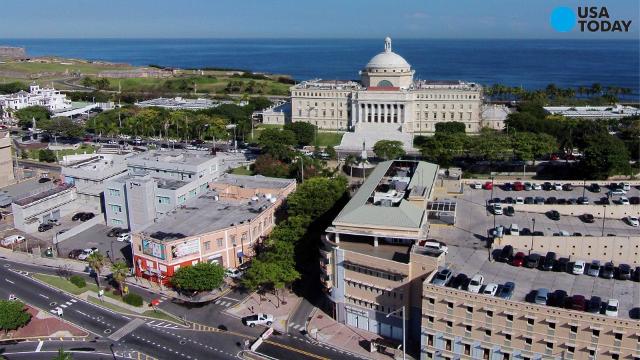
Puerto Rico's financial oversight board has filed a form of bankruptcy for the island under Title III of last year's Puerto Rico rescue law, which is known as PROMESA. USA TODAY

People face off with police during the general strike against austerity measures, which coincides with the International Workers Day, in San Juan, Puerto Rico, on May 1. (Photo: THAIS LLORCA, EPA)
Facing mountainous debt and population loss, the board overseeing Puerto Rico filed Wednesday for the equivalent of bankruptcy protection in a historic move that's sure to trigger a fierce legal battle with the fate of the island's citizens, creditors and workers at stake.
The oversight board appointed to lead the U.S. territory back to fiscal sustainability declared in a court filing that it is "unable to provide its citizens effective services," crushed by $74 billion in debts and $49 billion in pension liabilities.
The filing casts a shadow of uncertainty over the future of Puerto Rico pensioners, American retirees who own the island's debt, institutional investors who backed the island in good times and businesses with lucrative contracts.
But it could also provide hope to residents seeking to preserve access to basic services such as public safety and health care, while also offering a potential route to economic stability for an island that has been suffering for years. Puerto Rico officials have complained that their debt crisis has cut off funds needed to pay doctors and run schools.
Puerto Rico has lost 20% of its jobs since 2007 and 10% of its population, sparking an economic crisis that worsens by the day.
The island's response has worsened matters. Politicians raised taxes, allowed governmental bureaucracy to balloon, borrowed to pay the bills and promised pensions that the island could not afford.
"The result is that Puerto Rico can no longer fully pay its debt and pay for government services," the oversight board said in the court filing. "Nor can Puerto Rico refinance its debt — it no longer has access to the capital markets. In short, Puerto Rico’s crisis has reached a breaking point."
The island's slumping economy was, perhaps, the final straw. Some six in 10 Puerto Ricans are unemployed or not interested in working, and nearly half are enrolled in Medicaid.
Puerto Ricans are U.S. citizens and can move to the mainland at any time, draining the island's tax base. Tens of thousands have streamed into Florida.
The legal case is not technically considered a bankruptcy filing under the federal code that governs municipal cases, but it's similar. Instead, it was filed through a bankruptcy-like mechanism dubbed Title III of legislation authorized by Congress and signed into law by President Obama in 2016.
Here are key questions:
What happens next?
U.S. Supreme Court Chief Justice John Roberts will appoint a life-tenured judge, likely a U.S. District Court judge, to oversee the case, said Melissa Jacoby, a University of North Carolina law professor and expert on municipal bankruptcy.
That's different than Chapter 9 municipal bankruptcy cases, where a bankruptcy judge controls the process.
The person appointed to oversee the case will have significant power over how it unfolds.
This particular debt-cutting process has never occurred, so the lack of legal precedent could leave the judge with much sway over the future of Puerto Rico.
What does the oversight board do?
The oversight board will aim to negotiate debt cuts with creditors, after which it will propose a plan of adjustment. The judge will decide whether to authorize the plan, which could lead to massive debt cuts.
How will investors be treated?
They're in trouble.
To be sure, it depends on the status of their debt. If they hold secured bonds, they might get paid in full. But unsecured bondholders could suffer significant cuts, depending on which types of debt the judge determines to be vulnerable.
Financial creditors, including major investors that had bet on Puerto Rico bonds that were exempt from federal, state and local taxes, argue that their investments were made when the island was not eligible for bankruptcy.
But Congress passed the Puerto Rico Oversight, Management and Economic Stability Act (PROMESA) specifically to create a process that allows the island's numerous debt-saddled governmental entities to achieve debt relief.
Complicating matters is the various governmental entities included in the bankruptcy filing, each of which has its own investors and creditors wanting to be paid.
"It really isn’t clear how creditors stack up against each other," Jacoby said.
Moody's Investor Service Vice President Ted Hampton concluded Wednesday that the bankruptcy filing is actually "a positive step for bondholders overall" because it will bring about "orderly process that should be better for creditors in the aggregate than a chaotic and uncertain period involving proliferating lawsuits."
What happens to Puerto Rico pensioners?
They might face cuts because Puerto Rico has run out of pension funds.
In the Chapter 9 bankruptcy of Detroit, retirees agreed to accept cuts after a federal judge ruled that their pensions could be cut in municipal bankruptcy. That could pave the way for a similar ruling in Puerto Rico.
The PROMESA law states that the oversight board must identify a fiscal plan that will "provide adequate funding for public pension systems."
Puerto Rico pensioners also have certain legal protections, but inside of bankruptcy those protections can collapse. That's exactly what happened in Detroit.
That's why pension cuts and reductions to health care insurance could be in the cards.
But pensioners may still fare better than investors, Municipal Market Analytics analyst Matt Fabian suggested Tuesday in a research note. That's because pensioners are more politically empathetic than Wall Street creditors and bond insurers.
Could Puerto Rico sell off assets to pay some debts?
That's possible. In Detroit, which had $18 billion in debt, the city faced pressure from creditors and pensioners to consider selling off the city-owned Detroit Institute of Arts. The city instead negotiated a deal to avoid liquidating art and collected an infusion of cash from private donors and the state of Michigan.
The city could not be forced to sell assets because Chapter 9 bankruptcy prevents federal judges from ordering municipalities to take such actions.
Similarly, PROMESA dictates that the court may not "interfere with" the island's "property or revenues," without the oversight board's consent.
So a judge may not be able to order the island to sell off beachfront property.
But that doesn't mean creditors won't try to pressure the island into it.
"I wouldn’t be surprised because we’ve seen it in other contexts," Jacoby said.
Follow USA TODAY reporter Nathan Bomey on Twitter @NathanBomey.
13 reasons why a conversation about rape culture is as important as one about suicide

Embed
Share
Netflix says it will add more trigger warning to its show “13 Reasons Why”, given its graphic depiction of sexual assault and suicide. Maria Mercedes Galuppo (@mariamgaluppo) has more. Buzz60

Katherine Langford as Hannah in "13 Reasons Why." (Photo: Beth Dubber, Netflix)
Netflix's infinitely controversial 13 Reasons Why is billed as a show about teen suicide, but could be viewed as a more persuasive indictment of rape culture. (This story includes show spoilers and potentially triggering descriptions.)
The series — which explores the 13 reasons why its justice-seeking protagonist Hannah Baker (Katherine Langford) decided to end her life — is wildly popular among the young adult audience it courts, though it has sparked a ferocious debate among critics, parents, educators and mental health professionals about its graphic depiction of suicide. Defenders laud the show for its unflinching portrayal of fraught adolescence, while detractors argue it glamorizes suicide, ignores mental illness and perverts the reality of what happens after death.
The issue the show tackles most convincingly is sexual violence — its persistence in our schools, its dark evolution through social media and the trouble with our perception of consent. The show demonstrates how toxic masculinity feeds into rape culture — minimizing sexual violence, excusing perpetrators and blaming victims.
I think instead of just focusing on how to be nice to people we should really look at what society's rape culture is like. #13ReasonsWhy
— Molly Southall (@MollySouthall) April 19, 2017
Over the course of 13 episodes, Hannah is brutalized relentlessly: she is sexually objectified in a class poll, sexually harassed in school and on social media, sexually assaulted in public, stalked outside her home and raped at a house party. Perpetrators dehumanize her, friends dismiss her, the high school counselor fails her, and the wider student body stands idly by, complicit in her degradation.
"The reality is that if a girl hasn't experienced it herself, she's known somebody who has," said Lisa Maatz, vice president of government relations at the American Association of University Women (AAUW), which does tracking on sexual harassment and violence in K-12 schools and on college campuses. "It is part of their daily lives, part of their reality. And the scary thing is that it's not just part of their reality in college, it's part of their reality in high school, it's part of their reality in middle school and, quite frankly, it's sometimes part of their reality in elementary school."
Here's what happened in 13 Reasons Why, along with the statistics that show this isn't just Hannah's problem:
1. Sexual harassment in middle school and high school is pervasive
13 Reasons Why: In the first episode, Hannah has a late-night rendezvous at a nearby park with Justin Foley (Brandon Flynn), her high school crush. It's tame. She goes down a slide, he snaps a picture, they share a kiss. But the next day, we see Justin flaunting the photo to an all-male crew. The shot of Hannah he took is directly up her skirt, giving an innocent moment illicit pretense. Justin's friends eagerly share the deceptive shot with the rest of the school, which is enough for Liberty High to brand Hannah the class slut, making her the target of rampant sexual harassment in its halls.
Real life: A 2011 report by the AAUW found that nearly half of middle and high school students surveyed experienced some form of sexual harassment — unwanted sexual behavior that includes verbal or written comments, gestures, displaying pictures or images, or physical coercion — in the 2010–11 school year. Most (87%) of those students said it had a negative effect on them. Sexual harassment by text, e-mail, Facebook, or other electronic means affected nearly one-third of students.
i don't know whats more disgusting the toxic masculinity, male entitlement, and rape culture shown in 13 reasons why or how realistic it is
— Evvi (@OfficialEvvi) May 1, 2017
2. 'Hot or Not' is not harmless
13 Reasons Why: Hannah and her friend Jessica Davis (Alisha Boe) become victims of an insufferable high school tradition when male classmates circulate a "hot or not" list that votes Hannah "Best Ass" and Jessica "Worst Ass."
Real life: Research from the University of Kent shows there is a direct relation between the sexual objectification of girls and aggression towards them, and that the objectification-aggression link can start as early as the teenage years.
3. The pathway from bullying to sexual harassment to sexual violence
13 Reasons Why: While shopping at a local convenience store, Hannah is groped by popular jock Bryce Walker (Justin Prentice). She is groped again by Marcus Cole (Steven Silver), a member of the school's honor board, while on a date. Both boys were part of the crew that shared Justin's photo and helped craft the infamous "hot or not" list.
Real life: The CDC has documented a Bully-Sexual Violence Pathway, showing that as early as middle school, a pathway forms along which bullies transform into sexual harassers and age into perpetrators of sexual violence.
4. Stalking strikes fear into victims
13 Reasons Why: Hannah learns she's being stalked by someone taking pictures of her outside her bedroom window. Courtney Crimsen (Michele Selene Ang), the school's overachieving "nice" girl, offers to help Hannah uncover the identity of her stalker. The two hatch a plan and hunker down in Hannah's bedroom to execute it. While waiting, Courtney (who is gay but not out) dares Hannah to kiss her during a game of truth or dare. Hannah does, and while their lips lock the stalker shows up with his camera. Courtney and Hannah discover it's yearbook photographer Tyler Down (Devin Druid). When Hannah confronts Tyler, he agrees to delete the photos he took of her. But when he asks if she wants to "hang out," she incredulously laughs him off, and in retaliation he shares a photo of Hannah and Courtney kissing, though the picture is blurred enough that the girls' identities are in question.
Real life: “Stalking is a pattern of repeated and unwanted attention, harassment, contact, or any other course of conduct directed at a specific person that would cause a reasonable person to feel fear,” according to the Department of Justice. In the United States, the CDC reports an estimated 15.2% of women have experienced stalking during their lifetimes that made them feel very fearful or made them believe that they or someone close to them would be harmed or killed.
5. Spreading sexual rumors is sexual harassment, too
13 Reasons Why: Worried that her fellow classmates will identify her in the photo and discover she's gay, Courtney spreads a sexual rumor about Hannah to deflect attention from herself.
Real life: According to the National Women's Law Center, spreading rumors about a person's sexual behavior is considered sexual harassment under Title IX, a federal law that prohibits discrimination based on sex in schools.
6. Most people are not raped by a stranger
13 Reasons Why: Hannah and Jessica are both separately raped by Bryce.
Real life: According to RAINN, seven out of 10 rapes are committed by someone the victim knows. Sexual assaults of those under age 18 are committed by someone the victim knows 93% of the time.

Alisha Boe as Jessica in "13 Reasons Why." (Photo: Ron Koeberer/Netflix, Ron Koeberer/Netflix)
7. Bystander intervention is critical to stopping sexual assault
13 Reasons Why: Hannah witnesses Jessica's rape, but does not intervene. She hides in a closet, terrified.
Real life: The National Sexual Violence Resource Center (NSVRC) says that "people in a bystander role often describe feeling scared, alone, and afraid to say or do something in the face of violence." But the center's evidence shows bystanders can have a powerful impact on sexual violence prevention.
8. When silence still means 'no'
13 Reasons Why: When Hannah is raped by Bryce, she doesn't say "no," but there is no ambiguity about what happened. She doesn't object with words, but with her body. She tries to leave the hot tub before the assault. She physically resists. When Jessica is raped by Bryce, she is under the influence of alcohol and practically unconscious, unable to give consent and incapable of objecting.
Real life: If a person doesn't say, "no," that doesn't mean they're saying "yes." Consent means that two people agree to sexual activity. New data from the NSVRC found that 16% of people don't understand that sex without consent is rape. It also found that men and young adults show the lowest levels of awareness about what constitutes sexual violence.
9. Rape remains the most under-reported crime
13 Reasons Why: Neither Hannah nor Jessica reported their rapes to the police.
Real life: According to the NSVRC, 63% of sexual assaults go unreported; 0.6% of rapists are incarcerated, RAINN reports.
10. Sexual assault takes a profound toll on its victims
13 Reasons Why: After being raped, Jessica begins abusing alcohol.
Real life: According to the NSVRC, 81% of women report significant short-term or long-term impacts such as Post Traumatic Stress Disorder (PTSD), which increases the risk of alcohol abuse. Victims of sexual assault are 13 times more likely to abuse alcohol.
Rape costs survivors stress, trust, sleep and about $122,000
11. Perpetrators of sexual assault are experts at rationalizing their behavior
13 Reasons Why: When Hannah's friend Clay Jensen (Dylan Minnette), confronts Bryce about raping Hannah, first Bryce denies the rape, then he minimizes it, saying, "girls play games," and "she never said no."
Real life: Research shows that a perpetrator's "exaggerated sense of self-importance my facilitate their ability to rationalize their behavior."
12. Rape is often a silent epidemic
13 Reasons Why: Hannah does not discuss her rape with her parents or peers, but she does start to open up to a school counselor, who tells her that if she won't identify her attacker, she should "move on."
Real life: Among students who were sexually harassed in AAUW's 2011 study, only about 9% reported the incident to a teacher, guidance counselor or other adult at school, while just one-quarter of them said they talked about it with parents or family members (including siblings). Only about one-quarter spoke with friends.
13. Rape can have deadly consequences
13 Reasons Why: In the show's final episode, Hannah commits suicide.
Real life: According to the CDC, the likelihood of suicidal thoughts increases after sexual violence. Rape victims are 4.1 times more likely to have contemplated suicide and they are 13 times more likely to have attempted suicide.
So what do we do about it?
The AAUW has a number of recommendations to help prevent sexual harassment in schools. It stresses that students, parents and educators understand rights and responsibilities under Title IX, a federal law that prohibits sex discrimination in education. Parents and students should also have a copy of their school's sexual harassment policy.
If you're a student being harassed, tell an adult. If they don't listen, find another adult. Be persistent until you are taken seriously and given the support you need. The AAUW says the school is required by law to listen to you and take action.
If a friend tells you they've been sexually assaulted or abused, be supportive, avoid judgement and encourage them to get help. More on how to respond.
Supporting survivors of sexual #assault: Being a warm, compassionate human being is 99% of what’s helpful. https://t.co/ycnaXAeKnw@annieisipic.twitter.com/n2JXQafENr
— Seth J. Gillihan (@sethgillihan) April 6, 2017
If you're a bystander who sees someone being sexually harassed or assaulted, try to interrupt and stop it. Tell an adult. We are all responsible for preventing sexual assault.
If you want to make a difference, get involved in preventing sexual violence in your school. Work with a student group. If one doesn't exist, form one.
If you're a parent, model appropriate behavior (don't laugh at sexist jokes, don't reinforce gender stereotypes) and encourage your children to discuss their lives with you. Talk about what healthy sex and healthy dating looks like.
Schools should have a clear sexual harassment policy. They should also have an accessible list of resources for students who may be experiencing sexual harassment.
If you're an educator or counselor, make yourself approachable. Build trust. Support and validate students’ feelings when they do come to you.
Make sure kids learn early how to treat one another. According to Maatz, prevention is key: "We advocate for prevention activities in terms of bullying and harassment to start early. You've got to set the standards for appropriate behavior, and that's a much better strategy than reacting after something horrible has happened."
The cutting storyline in '13 Reasons Why' is scary but true
The National Sexual Assault Hotline is available 24/7: 800-656-HOPE (4673) or via online chat: online.rainn.org
Embed
Share
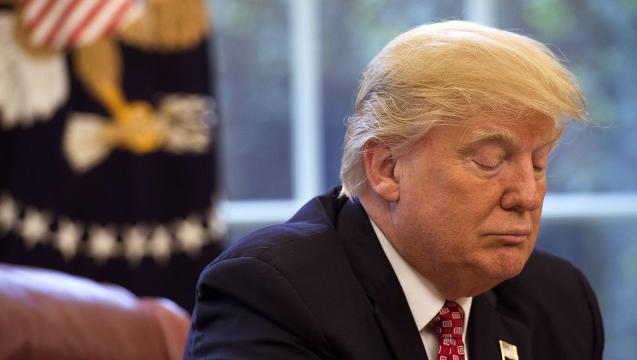
USA TODAY's Susan Page asks a panel of White House veterans and presidential scholars to offer President Trump advice after his first 100 days in the White House. USA TODAY
Day 1: Jan. 20
Trump is sworn in as president at noon on the West Front of the U.S. Capitol. In his first Oval Office appearance, before heading to inaugural balls, he signs an executive order directing agencies to find ways to "ease the burden" of Obamacare.
Day 2: Jan. 21
Trump makes an appearance at CIA headquarters, expressing his support for the intelligence community while attacking the media for reporting that he had a "feud" with them over investigations into Russian hacking and the election. He also criticizes media coverage of his inauguration, echoed later by press secretary Sean Spicer in an angry briefing room debut. Meanwhile, millions of people join Women's March protests around the world, including in Washington.
Day 3: Jan. 22
Trump starts the day with tweets touting his inauguration TV ratings and weighing in on the weekend protests against him: "Watched protests yesterday but was under the impression that we just had an election! Why didn't these people vote?" Top aide Kellyanne Conway makes waves with a Meet the Press appearance in which she says Spicer "gave alternative facts" in his press briefing in regard to inauguration crowd sizes.
Day 4: Jan. 23
Trump signs three presidential directives: withdrawing U.S. support for a Pacific trade deal; imposing a hiring freeze in civilian agencies; and restoring the so-called Mexico City policy that prohibits U.S. aid from supporting international groups that promote abortion. In a meeting with congressional leaders, Trump revives claims of voter fraud, blaming his popular vote loss on 3 million to 5 million people voting illegally.
Day 5: Jan. 24
Trump signs five executive actions on energy and infrastructure projects, including two memoranda intended to expedite the Keystone XL and Dakota Access pipelines. In a late-night tweet, he references plans to address one of his key campaign promises the following day: "Big day planned on NATIONAL SECURITY tomorrow. Among many other things, we will build the wall!"
Day 6: Jan. 25
Trump starts the day with tweets vowing a "major investigation" into alleged voter fraud. In the afternoon, he visits the Department of Homeland Security and signs executive actions aimed at building a wall on the Mexican border and clamping down on "sanctuary cities."
Day 7: Jan. 26
Trump floats a proposal for a 20% tax on imports from Mexico to pay for his planned border wall. His plans for the wall drive a divide between the two countries and lead Mexican President Enrique Peña Nieto to cancel a meeting between the two leaders. Trump takes his first Air Force One ride, traveling to Philadelphia to speak at the GOP congressional retreat.
Day 8: Jan. 27
Trump has an hourlong phone call with Mexican President Enrique Peña Nieto. He has his first official meeting with a foreign leader, British Prime Minister Theresa May. During their __news conference, Trump declines to say whether he supports a reduction of sanctions against Russia. He visits the Pentagon to charge his new Defense secretary with rebuilding the military and announce an executive action to clamp down on refugee admissions in the U.S.
Day 9: Jan. 28
Trump's executive order from the previous evening — which suspends the U.S. refugee program for 120 days, bans all immigrants from seven Muslim countries for 90 days, and orders the administration to develop "extreme vetting" measures — causes reverberations across the country, with stranded travelers, airport protests and legal challenges. The president makes a round of phone calls to world leaders, including Russian President Vladimir Putin. Trump also signs more executive orders: one to reorganize the National Security Council, another to strengthen ethics rules for the executive branch, and a third directing the military to present him a plan to defeat the Islamic State.
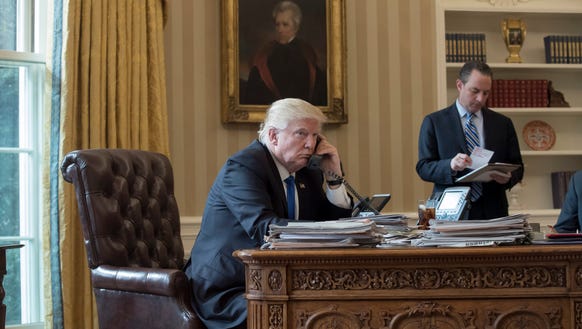
Trump speaks on the phone with Russian President Vladimir Putin in the Oval Office on Jan. 28, 2017. (Photo: Michael Reynolds, European Pressphoto Agency)
Day 10: Jan. 29
Trump, the target of protests, lawsuits and global criticism over his new refugee policy, takes to social media to defend it as a counter-terrorism measure. Some congressional Republicans suggest the order may have been too broad and hastily written. The president also faces blowback after giving chief strategist Steve Bannon an elevated role on the National Security Council.
Day 11: Jan. 30
Amid continued criticism over his temporary travel ban, Trump says that stopping terrorism involves hard choices and adds that he's following through on campaign pledges. Former president Barack Obama's office releases a statement that applauds those protesting the ban. That evening, acting Attorney General Sally Yates, a holdover from the Obama administration, says she won't defend the president’s travel ban in court. Three hours later, the White House announces that she's been relieved of her duties.
Day 12: Jan. 31
The morning after firing his acting attorney general, Trump mocks his Democratic congressional critics and demands that the Senate confirm his attorney general pick, Alabama Sen. Jeff Sessions. He meets with drugmakers and pledges to cut taxes and streamline regulations for the pharmaceutical industry in a bid to drive down drug prices. The president caps off the day with his long-awaited Supreme Court nomination, announcing his selection of Neil Gorsuch to fill the seat of the late Justice Antonin Scalia.
Day 13: Feb. 1
Trump says the Senate should "go nuclear" and eliminate Democratic filibuster rights if that's what it takes to confirm Gorsuch. His nomination of Betsy DeVos for Education secretary takes a hit when two Republican senators say they'll vote against her. The president makes an unannounced trip to a Delaware military base to receive the remains of a Navy SEAL killed during a counter-terrorism raid.
Day 14: Feb. 2
In remarks at the National Prayer Breakfast, Trump references leaked conversations between himself and Mexican and Australian leaders, telling attendees not to worry about his "tough phone calls" and that the country has to be "tougher" in meeting its challenges. He raises eyebrows by also asking for prayers for his Apprentice successor, Arnold Schwarzenegger, and the show's ratings, which Trump said have gone "down the tubes" in his absence. And he vows to make good on his promise to overturn the so-called Johnson Amendment, which bans public charities — including churches — from campaigning for or against a candidate for elected office.
Day 15: Feb. 3
The Trump administration imposes new sanctions on Iranian individuals and companies, citing the Tehran government's missile tests and support for rebels in Yemen. The president signs executive actions rolling back key financial regulations of the Obama era, including restrictions on Wall Street banks and on financial advisers who sell clients expensive financial products with higher commissions.
Day 16: Feb. 4
Trump spends his weekend at Mar-a-Lago, the "Winter White House." He asks a federal court to overturn a Seattle judge’s injunction halting his immigration ban, after he criticized the judge’s ruling as “ridiculous” and a “terrible decision.” In excerpts of a Fox __news interview with Bill O'Reilly set to air before the Super Bowl the following day, Trump reiterates his desire to improve relations with Russia and dismisses concerns that Putin is a “killer.”
Day 17: Feb 5
Trump continues to attack the federal judge who voided his travel ban. "Just cannot believe a judge would put our country in such peril," he tweets. "If something happens blame him and court system. People pouring in. Bad!" As the Justice Department appeals the judge's decision, Trump also tweets that he has "instructed Homeland Security to check people coming into our country VERY CAREFULLY. The courts are making the job very difficult!"

President Trump watches the Palm Beach Central High School marching band perform as it greets him upon his arrival to watch the Super Bowl at Trump International Golf Club Palm Beach in West Palm Beach, Fla., on Feb. 5, 2017. (Photo: Mandel Ngan, AFP/Getty Images)
Day 18: Feb. 6
As an appeals court reviews his travel ban, Trump claims that the public is with him, despite polls indicating otherwise. "Any negative polls are fake news, just like the CNN, ABC, NBC polls in the election," Trump tweets. "Sorry, people want border security and extreme vetting." In a visit to the headquarters of the U.S. Central Command in Tampa, Trump tells troops he is 100% behind them in the fight against "radical Islamic terrorism" and claims that "in many cases the very, very dishonest press doesn’t want to report" on terrorist attacks.
Day 19: Feb. 7
Trump tells a group of county sheriffs that he will help them fight terrorism and illegal immigration, and he vows to take his travel ban all the way to the Supreme Court if necessary. DeVos is confirmed as Education secretary after a contentious battle in the Senate, with Vice President Pence breaking a 50-50 tie vote. Later that day, the 9th U.S. Circuit Court of Appeals hears oral arguments over a lower court's decision to halt Trump's travel ban.
Day 20: Feb. 8
Trump urges the 9th U.S. Circuit Court of Appeals to uphold his travel ban, arguing that national security is at stake and suggesting that judges sometimes act politically. The president attacks Nordstrom for dropping daughter Ivanka's fashion line, drawing criticism for mixing government and his family's business interests. The Senate debate on the Sessions attorney general nomination turns ugly after Democratic Sen. Elizabeth Warren is silenced by the GOP during a speech for "impugning" Sessions.
Day 21: Feb. 9
Trump accuses Sen. Richard Blumenthal, D-Conn., of distorting what Gorsuch said about the president's attacks on judges, even though administration officials and fellow senators confirm the gist of Gorsuch's comments. The president also uses Twitter to attack Sen. John McCain over his criticism of the White House calling the Yemen raid a “huge success." Watchdog groups file ethics complaints against Conway for promoting Ivanka Trump's fashion line during a TV interview. The U.S. Court of Appeals for the 9th Circuit weighs in that evening, refusing to reinstate Trump's travel ban.
Day 22: Feb. 10
In a joint news conference with Japanese Prime Minister Shinzo Abe, Trump reaffirms the U.S. commitment to the defense of Japan but says both countries need to contribute more to military cooperation. He says he’ll take action the following week to strengthen border security in the wake of the appeals court ruling against his travel ban, but he declines to specify what that action might be. Meanwhile, a federal judge in Virginia blasts his travel ban, citing a lack of evidence that travelers from the seven Muslim-majority countries represent a specific threat.
Day 23: Feb. 11
Trump golfs with Abe at Trump National Jupiter Golf Club in Florida, while Melania Trump and Abe’s wife, Akie, spend the morning touring the Morikami Museum and Japanese Gardens in Palm Beach County. It's a relatively quiet day for the president on Twitter, with Trump vowing that cost estimates for his border wall will "come WAY DOWN" once he is involved with design and negotiations.
Day 24: Feb. 12
Trump takes to Twitter in the morning to again defend his travel ban. In Sunday show appearances, policy adviser Stephen Miller says the president is assessing all of his legal options on the ban, ranging from appealing to the Supreme Court to revising the executive order.
Day 25: Feb. 13
After a day filled with mounting questions and criticism, National Security Adviser Michael Flynn resigns, citing "incomplete information" that he provided White House officials about his dealings with the Russian ambassador. Earlier that day, Canadian Prime Minister Justin Trudeau visits the White House. Trump pledges "bridges of commerce" with Canada and says he wants relatively minor changes to NAFTA, adding that most of his problems with the trade deal involve the third partner, Mexico.
Day 26: Feb. 14
In the aftermath of Flynn's exit, Spicer says Trump knew for more than two weeks that Flynn lied about his contact with a Russian ambassador and demanded his resignation because he could no longer trust him. That night, The New York Times reports that phone records and intercepted calls show members of Trump's campaign team "had repeated contacts with senior Russian intelligence officials in the year before the election."
Day 27: Feb. 15
Amid the renewed questions about contacts between Trump's associates and Russia regarding the 2016 election, the president denounces "conspiracy theories" about his relationship with the Russians and said "illegal" news leaks brought down Flynn. Trump hosts Israeli Prime Minister Benjamin Netanyahu at the White House for a series of meetings. Andrew Puzder, the president’s embattled pick to become Labor secretary, withdraws his nomination.
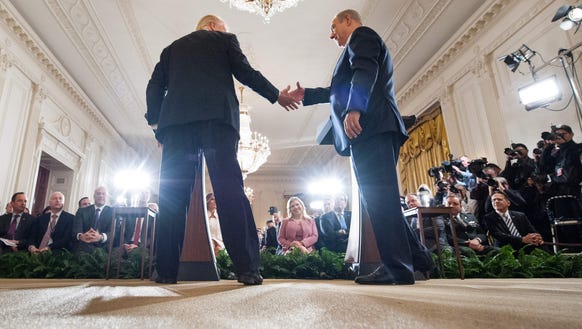
President Trump and Israeli Prime Minister Benjamin Netanyahu hold a joint press conference in the East Room of the White House on Feb. 15, 2017. (Photo: Mandel Ngan, AFP/Getty Images)
Day 28: Feb. 16
In a lengthy, fiery, wide-ranging news conference, Trump defends his administration as a "fine-tuned machine," laments the "mess" he inherited from his predecessor and excoriates the "fake news" media. He says he asked Flynn to resign because he misled Pence about his phone calls to the Russian ambassador, but Trump says he didn't believe Flynn did anything wrong by making the calls and faults leakers for providing contents of the intercepted calls to the media.
Day 29: Feb. 17
The Associated Press reports on the details of an internal Department of Homeland Security memo from January that proposes calling up as many as 100,000 National Guard troops to round up undocumented immigrants; it draws an angry response from the White House, with Spicer calling the AP report "100% not true" and insisting the memo is “not a White House document.” Trump conducts his first presidential visit beyond the Beltway with a stop in the Boeing facility in North Charleston, S.C., where he stresses his "America First" trade and economic policies.
Day 30: Feb. 18
Trump kicks off his third straight weekend at Mar-a-Lago seeking to calm reports of turmoil within his administration. "Don't believe the main stream (fake news) media.The White House is running VERY WELL. I inherited a MESS and am in the process of fixing it," he tweets that morning. He holds a campaign-style rally in the evening in Melbourne, Fla.
Day 31: Feb. 19
Trump is ridiculed for apparently denouncing a non-existent terrorist attack in Sweden in his rally the night before but says he was referring to a Fox News report on violence in Sweden allegedly perpetrated by refugees. In New York City, more than a thousand people protest Trump's travel ban in the "I Am A Muslim Too" rally.
Day 32: Feb. 20
Across the country, anti-Trump activists mark Presidents Day with “Not My Presidents Day” protests. The president spends the holiday at Mar-a-Lago and announces that Army Lt. Gen. H.R. McMaster will be his new national security adviser, replacing Flynn.

President Trump, right, shakes hands with Army Lt. Gen. H.R. McMaster, left, at Trump's Mar-a-Lago estate in Palm Beach, Fla., on Feb. 20, 2017, where he announced that McMaster will be the new national security adviser. (Photo: Susan Walsh, AP)
Day 33: Feb. 21
Trump speaks out against a series of bomb threats to Jewish community centers across the nation after coming under fire for sidestepping earlier opportunities to condemn several anti-Semitic acts since he took office. The Department of Homeland Security issues new directives to increase deportations among the country's 11 million undocumented immigrants.
Day 34: Feb. 22
Trump and his aides say they’ll roll out a proposed budget, a revamped health care plan and a new tax reform package over the following two months. The president, while meeting with budget officials, doesn't give specifics, but he tells reporters that "our moral duty to the taxpayer requires us to make our government leaner and more accountable” and “we must do a lot more with less.” Later that evening, the Trump administration issues new guidance on transgender students' restroom use, rolling back the policies put in place by the Obama administration last year.
Day 35: Feb. 23
Trump meets with manufacturing executives at the White House and later holds a listening session on human trafficking. The Conservative Political Action Conference kicks off just outside of Washington. White House Chief of Staff Reince Priebus and Bannon make a joint appearance at the annual confab, in which they dispute media reports casting them as rivals and say they are working together to advance the president's agenda.
Day 36: Feb. 24
Trump starts off the day criticizing FBI "leakers" as he and aides push back on news reports that his chief of staff asked the bureau to "knock down" stories about investigations into possible contacts between Trump campaign associates and Russian officials. At his CPAC speech later that morning, Trump launches into a full-throated attack on journalism, saying some reporters make up unnamed sources for "fake news" and describing the media as "the enemy" of the American people. News organizations protest a White House decision that afternoon to hold a news briefing by invitation only.
Day 37: Feb. 25
The president takes to Twitter in the morning with further complaints about the media. “The media has not reported that the National Debt in my first month went down by $12 billion vs a $200 billion increase in Obama first mo,” he tweets. In the evening, he announces via Twitter that he will not attend the annual White House Correspondents' Association Dinner in April.
Day 38: Feb. 26
The president tweets that the Democratic National Committee election "was of course, totally 'rigged' " and takes another swing at the media, tweeting, "Russia talk is FAKE news put out by the Dems, and played up by the media, in order to mask the big election defeat and the illegal leaks!" In the evening, Trump hosts the nation's governors for an annual dinner at the White House.
Day 39: Feb. 27
Trump signs off on top-line numbers in a budget outline that bolsters military spending while making deep cuts to other federal agencies. "This defense spending increase will be offset and paid for by finding greater savings and efficiencies across the federal government," he says. "We're going to do more with less." The president rejects the idea of a special prosecutor to look into Russian connections during the election and says, “I haven’t called Russia in 10 years."
Day 40: Feb. 28
Trump uses his first address to Congress to proclaim American greatness and push an ambitious agenda of economic nationalism, declaring, "The time for small thinking is over. The time for trivial fights is behind us." He opens the possibility of a comprehensive immigration deal, pitches $1 trillion for "Buy American, Hire American" infrastructure spending, and says he will propose "historic" tax cuts. Earlier that day, the president signs executive orders targeting a water-protection rule and elevating an initiative on historically black colleges and universities.

President Trump speaks before a joint session of Congress on Feb. 28, 2017. (Photo: Andrew P. Scott, USA TODAY)
Day 41: March 1
A day after Trump struck a more conciliatory tone in his address to Congress, critics predict he'll revert back to the more combative and divisive approach that characterized much of his first month in office. Aides, however, say the president is focused on enacting his campaign agenda. White House Deputy Counsel Stefan Passantino says in a letter that Conway did nothing "nefarious" when she promoted Ivanka Trump's fashion line on television and that a White House inquiry "concluded that Ms. Conway acted inadvertently and is highly unlikely to do so again."
Day 42: March 2
The news of Sessions' 2016 meetings with the Russian ambassador, contradicting his testimony during his confirmation hearing that he had no contact with the Russian government during the campaign, dominates the day. Trump says he "wasn't aware at all" of the meetings. Speaking to reporters during a tour of the USS Gerald Ford in Newport News, Va., the president says he still had "total" confidence in his attorney general. Later that afternoon, Session recuses himself from the Russia investigation.
Day 43: March 3
Seeking to get past stories about Sessions and Russia, Trump spends the day visiting a school in Florida. He uses Twitter to express his displeasure with Democrats, knocking them over his full Cabinet having not yet been approved and calling Senate Minority Leader Chuck Schumer a "hypocrite" in a tweet displaying a 2003 photo of Schumer and Putin.
Day 44: March 4
In a morning tweetstorm, Trump accuses Obama of wiretapping him at Trump Tower prior to the November election: "Terrible! Just found out that Obama had my 'wires tapped' in Trump Tower just before the victory. Nothing found. This is McCarthyism!" the president tweets. An Obama spokesman rejects the accusation as "simply false." Thousands of Trump supporters convene near Trump Tower and in other cities around the U.S. in what organizers bill as "March 4 Trump" demonstrations on behalf of the president.
Day 45: March 5
In the morning, the president calls for a congressional investigation of his claims that Obama had him wiretapped during the election — while critics accuse Trump of trying to distract from the investigation into his own relationship with Russia. That evening, news reports indicate that FBI Director James Comey over the weekend sought a public rebuke from the Justice Department of Trump's wiretapping claim.
Day 46: March 6
Trump issues the long-awaited revised version of his travel ban, which no longer restricts travel from Iraq, one of the seven majority Muslim countries listed in his original order. The new order, set to take effect 10 days afterward, includes Iran, Libya, Somalia, Syria, Sudan and Yemen as part of the 90-day ban. Meanwhile, when White House deputy press secretary Sarah Sanders is asked on ABC's Good Morning America whether the president accepts Comey's statement that Obama did not authorize any wiretaps, she says: "You know, I don't think he does."
Day 47: March 7
Trump kicks off the day by using Twitter to again bash Obama — this time in a false claim about Guantanamo Bay prisoner releases. He also denies reports of dissension within his staff. "Don't let the FAKE NEWS tell you that there is big infighting in the Trump Admin," the president tweets. He praises the House GOP health care bill amid pushback from conservatives attacking the new plan. "We're going to do something that is great," the president says during a meeting with House deputy whips. The plan is "complicated, but it's very simple ... it's called good health care."

President Trump greets Jack Cornish, 10, of Birmingham, Ala., while Cornish was touring the White House. It was the first day of White House tours for the public since Trump was inaugurated. (Photo: Erik S. Lesser, European Pressphoto Agency)
Day 48: March 8
While refusing to confirm or deny the authenticity of CIA documents released by WikiLeaks, Spicer says that "this alleged leak should concern every single American in terms of the impact it has on our national security" and says there's a "massive, massive difference" between exposing the emails of Clinton campaign chairman John Podesta and other Democratic officials, and leaking national security secrets. The president dines with former foe Sen. Ted Cruz. Sens. Lindsey Graham and Sheldon Whitehouse send a letter to the FBI director and acting deputy attorney general asking for specific information on Trump's wiretapping accusation against Obama.
Day 49: March 9
Trump meets with his National Economic Council and representatives of community banks. As GOP leaders try to quell concerns about the new health care legislation, the president tweets, "Despite what you hear in the press, healthcare is coming along great. We are talking to many groups and it will end in a beautiful picture!" Meanwhile, legal challenges mount from several states for Trump's revised travel ban.
Day 50: March 10
As the president reaches the halfway point of his first 100 days, administration officials kick off a plan to use social media and interviews to promote "50 days of action." Trump meets with House committee leaders and predicts a fairly rapid approval of the GOP health care bill. "This is the time we’re going to get it done," he says. "I think it’s just something that’s going to happen very shortly." He welcomes a better-than-expected jobs report showing that the economy added 235,000 jobs the previous month.
Day 51: March 11
Trump has lunch with a group of White House staff and Cabinet members at Trump National Golf Club in Sterling, Va. His administration moves forward with plans to dismiss 46 U.S. attorneys held over from the Obama administration amid criticism, and news reports emerge that an intruder was arrested on the White House grounds after scaling a fence the previous evening.
Day 52: March 12
Trump administration officials mount a vigorous defense of their effort to repeal and replace Obamacare while bracing for what could be a skeptical assessment from the Congressional Budget Office the next day. Speaking on NBC's Meet the Press, Health and Human Services Secretary Tom Price says the bill would lead to "more people covered than are covered right now, and at an average cost that is less."
Day 53: March 13
The CBO releases its analysis of the GOP health plan, determining that the bill would lead to 14 million fewer Americans with insurance by 2018 and 24 million by 2026. Price calls the projections "just not believable." Trump launches an ambitious effort to reorganize the federal government, signing an executive order that he said would "make it less wasteful and more productive."
Day 54: March 14
A senior White House official confirms that Trump paid $38 million in taxes in 2005 on an income of more than $150 million. The rare acknowledgement came in anticipation of a report by MSNBC's Rachel Maddow in which she disclosed a portion of the return. The news capped off an otherwise relatively quite day for the president during which Spicer pushed back against the CBO analysis of the Obamacare repeal and Trump hosted the deputy crown prince of Saudi Arabia for lunch in the State Dining Room.
Day 55: March 15
A federal judge in Hawaii issues a nationwide halt to Trump's second travel ban. Earlier that day, the president spars on Twitter with journalist David Cay Johnston over the previous night's leaked tax return, tweeting, "Does anybody really believe that a reporter, who nobody ever heard of, 'went to his mailbox' and found my tax returns?" Trump also travels to Detroit to speak to autoworkers before heading to a rally in Nashville.
Day 56: March 16
In his first formal budget proposal to Congress, Trump seeks to increase defense spending by $54 billion and offsets that with cuts to non-defense spending, including steep cuts to education, environmental protection, health and human services and foreign aid. Senate Intelligence Committee leaders say in a statement that there are "no indications that Trump Tower was the subject of surveillance," a day after the House Intelligence panel offered a similar assessment. Trump also meets with Irish leader Enda Kenny and attends the Friends of Ireland Luncheon on Capitol Hill.
Day 57: March 17
Disputing media reports that the GOP health care bill is in political trouble, Trump says he is "100% behind" the plan and is working with skeptical conservatives. He welcomes German Chancellor Angela Merkel to the White House after months of back-and-forth between the two leaders. During their news conference, Trump again defends his surveillance allegations. "At least we have something in common, perhaps," he says, referencing past disclosures during the Obama administration that Merkel's cellphone had been monitored.
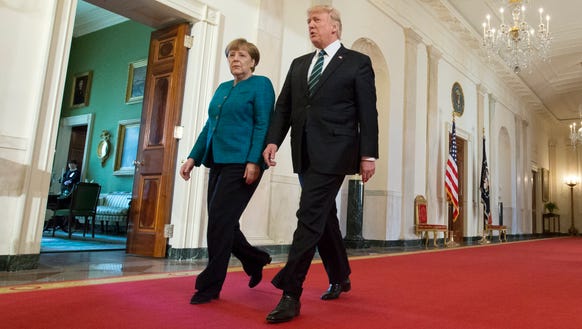
Trump and German Chancellor Angela Merkel walk down the Cross Hall to enter the East Room for a joint press conference at the White House on March 17, 2017. (Photo: Michael Reynolds, European Pressphoto Agency)
Day 58: March 18
The president spends the weekend at Mar-a-Lago. In a pair of morning tweets, Trump lashes out at the media and Germany: "Despite what you have heard from the FAKE NEWS, I had a GREAT meeting with German Chancellor Angela Merkel. Nevertheless, Germany owes ... vast sums of money to NATO & the United States must be paid more for the powerful, and very expensive, defense it provides to Germany!" Meanwhile, at the White House, the Secret Service apprehends a person who jumped a bike rack near the security perimeter.
Day 59: March 19
A day before a high-stakes hearing featuring Comey's testimony, the leaders of the House Intelligence Committee say on Sunday talk shows that there's no evidence to back Trump's claims that Obama wiretapped him, though the committee's chairman, Rep. Devin Nunes, says investigators are looking at other types of possible surveillance of Trump and his aides during the campaign.
Day 60: March 20
Appearing before the House Intelligence Committee, Comey says the FBI and DOJ have "no information to support’’ Trump’s assertions that Obama wiretapped him, and he also confirms for the first time publicly that the FBI is investigating Russian interference in the election. Trump heads to Kentucky to take part in a rally to build support for the GOP health care bill.
Day 61: March 21
The morning after congressional Republicans released a modified version of their health care legislation seeking to win more conservative votes, Trump meets with GOP lawmakers on Capitol Hill, emphasizing how important it is that they stay united to pass the legislation. The president also signs a $19.5 billion bill to fund NASA programs and reaffirm what he called a "national commitment" to "human space exploration."
Day 62: March 22
The White House dismisses a report that Trump's former campaign chairman, Paul Manafort, received a $10 million contract a decade ago to advance the interests of Putin. Nunes says communications involving members of Trump's transition group were "incidentally collected'' by intelligence officials after the election. The president meets with members of the Congressional Black Caucus, and negotiations continue over the looming health care vote in the House.
Day 63: March 23
In a setback to Trump and Speaker Paul Ryan's efforts to repeal Obamacare, the House postpones its vote on the bill as negotiations continue with both conservative and moderate groups. The president touts the House Intelligence chairman's assertion that spy agencies engaged in "incidental collection" of Trump associates' communications, saying it's evidence to support his claim that Obama "wiretapped" Trump Tower. Trump also holds a listening session on health care at the White House with truckers and trucking CEOs.

President Trump gets in the driver's seat of an 18-wheeler while meeting with truck drivers and trucking CEOs on the South Portico prior to their meeting to discuss health care at the White House on March 23, 2017. (Photo: Jim Lo Scalzo, European Pressphoto Agency)
Day 64: March 24
As the Obamacare repeal bill bleeds GOP support ahead of its rescheduled vote, Ryan pulls the legislation from consideration — a major bump in the road for Trump's campaign promise to repeal and replace the health care law. The president blames the bill's failure on the lack of Democratic support. Earlier that day, Trump signs a permit to allow the construction of the Keystone XL pipeline, calling it "a great day for American jobs."
Day 65: March 25
The morning after Republicans' Obamacare repeal plan fell apart in Congress, Trump tweets, "ObamaCare will explode and we will all get together and piece together a great healthcare plan for THE PEOPLE. Do not worry!" The president stays in the D.C. area for the weekend, venturing to Trump National Golf Club in Sterling, Va.
Day 66: March 26
Trump takes aim at the House Freedom Caucus in a morning tweet: "Democrats are smiling in D.C. that the Freedom Caucus, with the help of Club For Growth and Heritage, have saved Planned Parenthood & Ocare!" In Sunday show appearances, Priebus and budget director Mick Mulvaney say Trump has not blamed Ryan for the failure of the Obamacare repeal bill.
Day 67: March 27
Trump taps son-in-law Jared Kushner to lead a new White House office designed to bring ideas from the private sector into the federal government. The president rolls back more Obama-era regulations, signing four bills that reverse rules on education, land use and federal purchasing, and he holds a meeting at the White House with female small-business owners.
Day 68: March 28
Trump signs an executive order on energy independence, a sweeping repudiation of Obama-era environmental initiatives that substitutes a strategy of combating climate change through international cooperation for an America-first energy policy. Nunes faces pressure to recuse himself or step down as leader of the investigation of Russian meddling in the 2016 presidential election.
Day 69: March 29
The president kicks off the day with complaints on Twitter about the media. "Remember when the failing @nytimes apologized to its subscribers, right after the election, because their coverage was so wrong. Now worse!" he tweets. Trump later holds an opioid abuse listening session, joined by New Jersey Gov. Chris Christie, leader of the White House's new commission to combat the opioid crisis.
Day 70: March 30
Trump takes to Twitter to threaten the conservative group that opposed him on health care: "The Freedom Caucus will hurt the entire Republican agenda if they don't get on the team, & fast. We must fight them, & Dems, in 2018! " Later that day, The New York Times reports that two White House officials played a role in providing intelligence reports to Nunes. The president meets with Denmark’s prime minister, Lars Lokke Rasmussen.

President Trump greets Denmark's prime minister, Lars Lokke Rasmussen, outside the West Wing of the White House on March 30, 2017. (Photo: Brendan Smialowski, AFP/Getty Images)
Day 71: March 31
While Trump encourages Flynn to offer testimony to investigators in exchange for immunity, congressional leaders investigating Russia's interference in the election signal that it's too early to consider such an agreement. Trump promises to crack down on "foreign importers that cheat" with two executive orders that he said would lead to a historic reversal of the nation's trade deficit.
Day 72: April 1
Trump kicks off another Saturday with tweets attacking the media, with NBC's Chuck Todd as the target: "When will Sleepy Eyes Chuck Todd and @NBCNews start talking about the Obama SURVEILLANCE SCANDAL and stop with the Fake Trump/Russia story?" The president also uses Twitter to praise a New York Times article on Obamacare, though he still describes the newspaper as "failing."
Day 73: April 2
Trump expresses confidence, both on social media and at the golf course, that he and aides can resurrect their attempt to repeal Obamacare. Before hitting the links with one of his critics on health care, Republican Sen. Rand Paul, the president tweets: "Anybody (especially Fake News media) who thinks that Repeal & Replace of ObamaCare is dead does not know the love and strength in R Party!"
Day 74: April 3
Trump welcomes Egyptian President Abdel Fattah al-Sisi to the White House, praises him for doing a "fantastic job," and solicits his help in the fight against terrorism. The president donates $78,333.32 — his salary since taking office — to the National Park Service. Senate Democrats reach the threshold required to block Gorsuch's confirmation, setting up a major Senate rules change later in the week for the GOP to advance the Supreme Court nomination.
Day 75: April 4
Former national security adviser Susan Rice, appearing on MSNBC, says she didn't seek to "unmask" the names of Trump associates for political purposes. Meanwhile, in a statement on a chemical attack in Syria, Trump blames the Assad regime and calls it a consequence of the Obama administration’s “weakness and irresolution.” The president promotes his "America First" domestic plan at the North America’s Building Trades Unions national legislative conference.
Day 76: April 5
A senior White House official confirms Trump has removed Bannon from the National Security Council and says Bannon was given the post as a check on Flynn. In an interview with The New York Times, Trump floats the possibility that Rice committed a crime, but he provides no evidence. In a news conference with Jordan's King Abdullah, the president denounces the chemical attack in Syria and suggests his administration will develop a new policy toward Bashar al-Assad's government.
Day 77: April 6
Trump orders a cruise missile strike against Syria, saying "no child of God should ever suffer" the horror of the chemical weapons attack Syria launched on its own people. Earlier that day, Trump meets with Wounded Warriors at the White House before heading to Mar-a-Lago to host a summit with Chinese President Xi Jinping, and Senate Republicans invoke the "nuclear option" to strip Democrats of their power to block Trump's Supreme Court nominee from being confirmed.
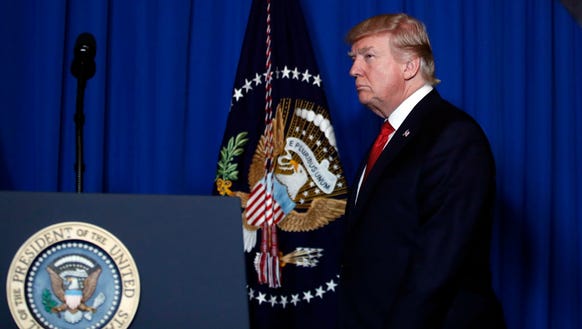
President Trump walks to the podium to speak about the missile strike on Syria on April 6, 2017, at Mar-a-Lago in Palm Beach, Fla. (Photo: Alex Brandon, AP)
Day 78: April 7
Trump's decision to strike Syria in retaliation for a chemical weapons attack draws wide political support, though some lawmakers say he should have consulted with Congress, while Russia said the strike would undermine international cooperation. The president concludes his meetings with the Chinese president at Mar-a-Lago, and his Supreme Court nominee is confirmed by the Senate.
Day 79: April 8
Trump does not rule out additional military action against Syria, telling Congress that he was acting "in the vital national security and foreign policy interests of the United States" when he ordered the launch of cruise missiles at a Syrian air field. He provides his justification in a letter to Congress under the War Powers Resolution. Kushner and Bannon hold a negotiation session to try to mend a rift that triggered speculation about a White House staff shakeup.
Day 80: April 9
Administration officials confirm that Trump will ask K.T. McFarland to step down as deputy national security adviser and serve instead as ambassador to Singapore, giving McMaster a chance to pick his own lieutenant. The president heads back to D.C. in the afternoon following a weekend at Mar-a-Lago.
Day 81: April 10
Trump takes part in the swearing-in ceremony for Gorsuch. The White House echoes its threat of additional missile strikes against Syria if Assad's government again uses chemical weapons, and Trump aides say the administration is reworking its tax reform plan and doesn't know whether it can put together a final proposal before Congress' August recess.
Day 82: April 11
Spicer makes waves during the daily briefing when he states, while comparing Assad and Adolf Hitler, that Hitler "didn't even use chemical weapons." He attempts to clarify by saying Hitler "was not using the gas on his own people the same way that Assad is doing." In a second attempt to clarify, he says he was "trying to draw a contrast of the tactic of using airplanes to drop chemical weapons on innocent people." Meanwhile, the White House says there's overwhelming evidence that Syria used a sarin nerve agent to attack opponents of the government and that Russia is trying to help Assad's government cover up the illegal use of chemical weapons.
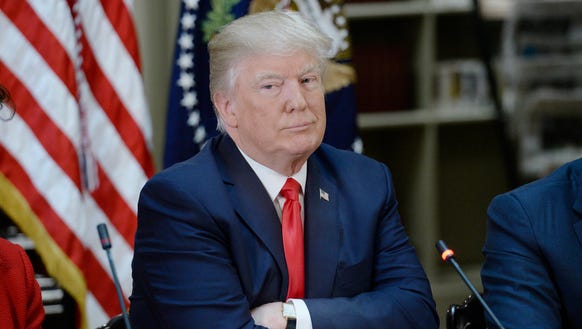
President Trump speaks during a strategic and policy discussion with CEOs in the State Department Library in the Eisenhower Executive Office Building in Washington on April 11, 2017. (Photo: Olivier Douliery, Pool/European Pressphoto Agency)
Day 83: April 12
Trump meets with NATO Secretary-General Jens Stoltenberg and says at a press conference afterward that he's satisfied that NATO has responded to the criticism he leveled at it during his campaign: "I said it was obsolete. It is no longer obsolete." He also says relations with Russia "may be at an all-time low" following Syria's use of chemical weapons the previous week and the U.S. airstrike that followed.
Day 84: April 13
The U.S. military announces an attack on an Islamic State tunnel complex in Afghanistan, and Trump says he endorsed the strike. Asked about the use of the "mother of all bombs," Trump says "what I do is I authorize my military. ... We have given them total authorization and that’s what they’re doing and frankly that’s why they’ve been so successful lately." The president tweets on foreign policy, including on North Korea: "I have great confidence that China will properly deal with North Korea. If they are unable to do so, the U.S., with its allies, will! U.S.A."
Day 85: April 14
Trump hits the golf course at Mar-a-Lago as he and his aides braced for what North Korea calls a "big event." Administration officials say they are hopeful that China can dissuade its communist neighbor from conducting a nuclear explosion or a missile test. The Trump administration says records of visitors to the White House will stay secret until at least five years after Trump leaves office, a reversal of policy quickly denounced by advocates of transparent government.
Day 86: April 15
North Korea attempts to launch a new missile, but the device blows up almost immediately. Pence arrives in Seoul hours after the failed missile test and says U.S. resolve to support and defend South Korea is unwavering "in these troubled times." Meanwhile, thousands of protesters gather in U.S. cities for Tax Day rallies and marches, demanding that Trump release his tax returns.
Day 87: April 16
The Trump administration takes a low-key approach to the previous day's failed missile test in North Korea and continues to express hope that China will rein in its nuclear-armed neighbor. The president says he's unimpressed with tax protests over the weekend and indicates he has no plans to release his tax returns anytime soon. "Someone should look into who paid for the small organized rallies yesterday. The election is over!" Trump tweets. He returns to D.C. after spending Easter weekend in Mar-a-Lago.
Day 88: April 17
Trump marks his first Easter Egg Roll by defending his record in office. "We will be stronger and bigger and better as a nation than ever before and we are right on track," he says during remarks on the South Portico balcony. The White House declines to detail Trump's future strategy toward North Korea, even as its government threatens more missile tests. "I think that the action that he took in Syria shows that when appropriate this president will take decisive action," Spicer says.
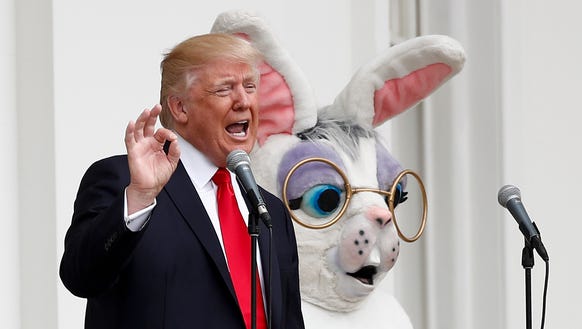
President Trump, joined by the Easter Bunny, speaks from the Truman Balcony during the White House Easter Egg Roll on April,17, 2017. (Photo: Carolyn Kaster, AP)
Day 89: April 18
Trump heads to Snap-On Tools in Kenosha, Wis., to speak about manufacturing and sign a "Buy American, Hire American" executive order. The order clamps down on guest worker visas and requires agencies to buy more goods and services from U.S. companies and workers. Watchdog group Citizens for Responsibility and Ethics in Washington expands a lawsuit against the president, adding new plaintiffs who claim they are hurt by the "unfair" advantage he enjoys in the hotel and restaurant industry.
Day 90: April 19
With the closely watched special election in Georgia headed to a runoff, Trump pats himself on the back: "Despite major outside money, FAKE media support and eleven Republican candidates, BIG "R" win with runoff in Georgia. Glad to be of help!" he tweets. He signs the Veterans Choice Program Extension and Improvement Act and welcomes the Super Bowl champion New England Patriots to the White House.
Day 91: April 20
The Trump administration launches an investigation into whether steel imports threaten national security, a move aimed at China's growing dominance in steel production. The president welcomes Italian Prime Minister Paolo Gentiloni to the White House. During their joint press conference, Trump says he's confident he can block North Korea's nuclear program, get a health care bill though the House, and avoid a looming government shutdown.
Day 92: April 21
With a little over a week before Trump hits the 100-day mark of his presidency, he tweets, "No matter how much I accomplish during the ridiculous standard of the first 100 days, & it has been a lot (including S.C.), media will kill!" Trump aims to dismantle even more financial regulations with executive orders, directing Treasury officials to take another look at tax rules and oversight of "too big to fail" financial institutions. The president also says he intends to unveil a tax reform plan the following week.
Day 93: April 22
Trump announces his plans for the night of the annual dinner of White House correspondents — and the 100th day of his presidency. "Next Saturday night I will be holding a BIG rally in Pennsylvania. Look forward to it!" he tweets. He makes his his first official visit to Walter Reed National Military Medical Center, awarding a Purple Heart to a soldier injured in Afghanistan. People take part in protests across the country as part of the the March for Science.
Day 94: April 23
As the 100-day mark approaches, Trump and his staff plan a busy week of events — including a new tax reform outline, a renewed effort to get a health care bill through the House, a high-profile National Rifle Association speech and a 100th day rally in Pennsylvania — all topped by the need for a new spending bill to keep the government open.
Day 95: April 24
Trump speaks with astronauts aboard the International Space Station, lauding NASA's work and praising a crew member who set a record for longest time spent in space. As his administration slaps new sanctions on Syria, Trump tells a group of U.N. diplomats that they need to work harder to confront the Syrian government and other "serious and growing threats" such as North Korea. He attempts to atone for past blunders on the history of the Holocaust with a strongly worded Week of Remembrance proclamation, pledging that "we must never forget" the annihilation of 6 million Jews by Nazi Germany.
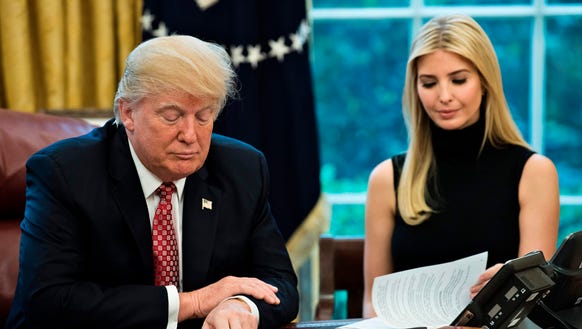
President Trump and daughter Ivanka Trump look at their notes while speaking via video with NASA astronauts aboard the International Space Station from the Oval Office of the White House on April 24, 2017. (Photo: Brendan Smialowski, AFP/Getty Images)
Day 96: April 25
Trump vows to fight anti-Semitic violence during a ceremony at the U.S. Capitol to commemorate the memory of the Holocaust. "Those who deny the Holocaust are an accomplice to this horrible evil, and we will never be silent," Trump says. Later that day, the president expresses confidence that he'll be able to build a wall along the Southwest border but stops short of saying whether he would insist that money to finance the barrier be included in a new spending bill to keep the government open past the end of the week.
Day 97: April 26
Trump signs an executive order calling into question the future of more than two dozen national monuments proclaimed by the last three presidents to set aside millions of acres from development. The administration pitches a tax reform outline calling for big corporate rate cuts, a simpler tax code and big increases in standard deductions. After briefing senators at a White House meeting, members of Trump's national security team said they're trying to coerce North Korea into giving up its nuclear weapons program by cutting off foreign money they need to finance it.
Day 98: April 27
Trump signs an executive order seeking to provide more protections to whistle-blowers at the Department of Veterans Affairs. A week after directing a wide-ranging investigation into whether foreign steel poses a threat to U.S. national security, Trump signs an order doing the same for aluminum. He welcomes Argentinian President Mauricio Macri and first lady Juliana Awada to the White House.
Day 99: April 28
Congress passes a stopgap funding bill to keep the government open another week, eliminating the threat of a shutdown starting on Trump's 100th day in office. He signs an executive order that could eventually open up Arctic waters and millions of coastal acres off U.S. shores to oil and gas drilling. He heads to Atlanta to speak at the National Rifle Association convention, where he vows to defend gun rights and reminisces about his election victory.
Day 100: April 29
Trump is set to hold a campaign rally in Harrisburg, Pa., as White House correspondents hold their annual dinner in Washington that is traditionally attended by the president.
Contributing: Katie Smith, David Jackson, Gregory Korte, Donovan Slack
USA TODAY coverage of Trump's first 100 days:
100 days into Trump presidency, Americans are united on this: They're divided
Trump’s 5 biggest wins and losses in Congress in his first 100 days
One Republican congressman's wild ride on the Trump train
In Gettysburg speech, Trump made 100 days of promises. Did he keep them?
Pence's first 100 days: He's stayed above the fray, but what does that say about his influence?
The Trump years: Hope, fear, elation and angst in 100 days
No regrets: 100% approval at 100 days from these Trump voters
Chuck Schumer, President Trump don't talk much in first 100 days
What did Trump tweet in his first 100 days?
Analysis: A bumpy 100 days for Trump? Just wait for the 1,361 to follow
Ronald Reagan to Donald Trump: Comparing first 100 days of last six presidents
USA TODAY roundtable: Advice for Trump? Take a deep breath
Posted!
A link has been posted to your Facebook feed.


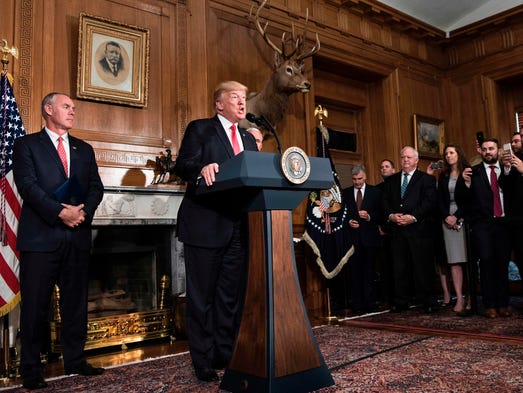


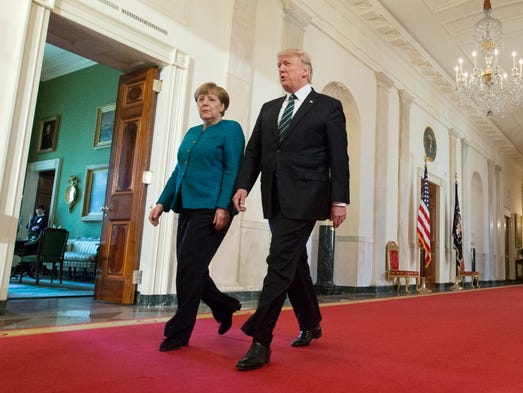
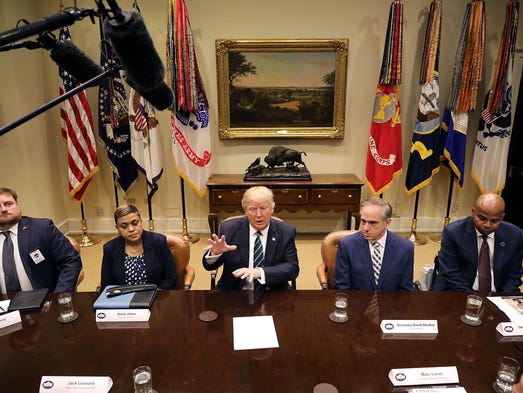
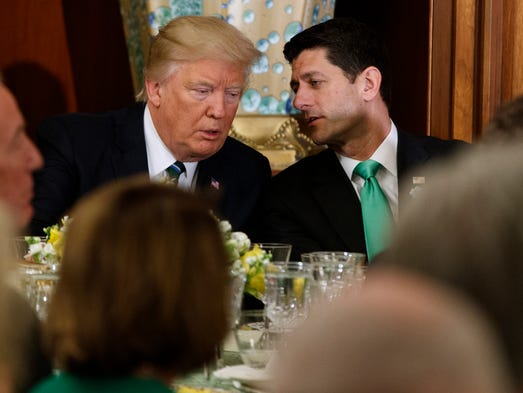
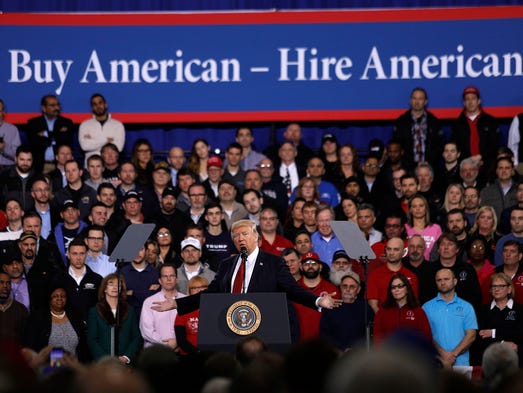

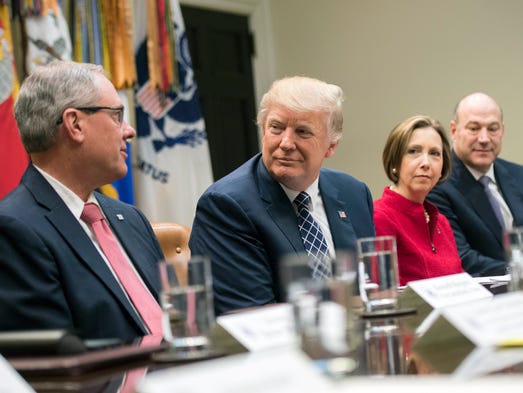
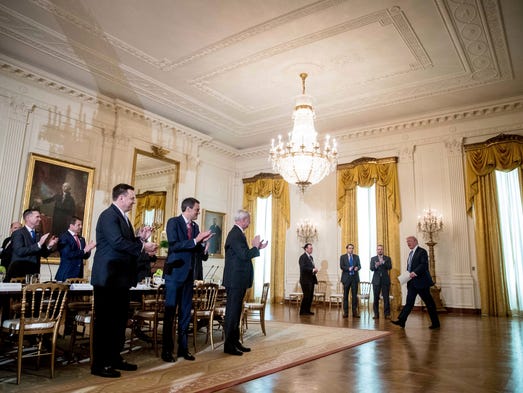


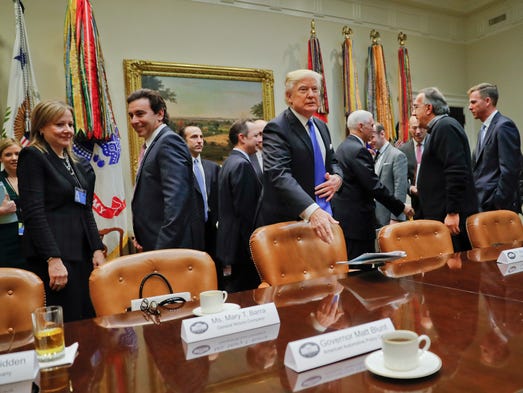


Like this topic? You may also like these photo galleries:
-
 1 of 87
 -
 2 of 87
 -
 3 of 87
 -
 4 of 87
 -
 5 of 87
 -
 6 of 87
 -
 7 of 87
 -
 8 of 87
 -
 9 of 87
 -
 10 of 87
 -
 11 of 87
 -
 12 of 87
 -
 13 of 87
 -
 14 of 87
 -
 15 of 87
 -
 16 of 87
 -
 17 of 87
 -
 18 of 87
 -
 19 of 87
 -
 20 of 87
 -
 21 of 87
 -
 22 of 87
 -
 23 of 87
 -
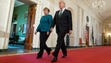 24 of 87
 -
 25 of 87
 -
 26 of 87
 -
 27 of 87
 -
 28 of 87
 -
 29 of 87
 -
 30 of 87
 -
 31 of 87
 -
 32 of 87
 -
 33 of 87
 -
 34 of 87
 -
 35 of 87
 -
 36 of 87
 -
 37 of 87
 -
 38 of 87
 -
 39 of 87
 -
 40 of 87
 -
 41 of 87
 -
 42 of 87
 -
 43 of 87
 -
 44 of 87
 -
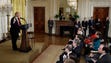 45 of 87
 -
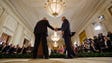 46 of 87
 -
 47 of 87
 -
 48 of 87
 -
 49 of 87
 -
 50 of 87
 -
 51 of 87
 -
 52 of 87
 -
 53 of 87
 -
 54 of 87
 -
 55 of 87
 -
 56 of 87
 -
 57 of 87
 -
 58 of 87
 -
 59 of 87
 -
 60 of 87
 -
 61 of 87
 -
 62 of 87
 -
 63 of 87
 -
 64 of 87
 -
 65 of 87
 -
 66 of 87
 -
 67 of 87
 -
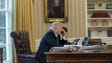 68 of 87
 -
 69 of 87
 -
 70 of 87
 -
 71 of 87
 -
 72 of 87
 -
 73 of 87
 -
 74 of 87
 -
 75 of 87
 -
 76 of 87
 -
 77 of 87
 -
 78 of 87
 -
 79 of 87
 -
 80 of 87
 -
 81 of 87
 -
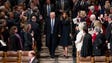 82 of 87
 -
 83 of 87
 -
 84 of 87
 -
 85 of 87
 -
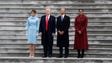 86 of 87
 -
 87 of 87


